Nikan Fujii, Bukkyo University
Isobel Hook, Kwansei Gakuin University
Abstract
The integration of artificial intelligence (AI) tools, particularly generative and communicative AI, is transforming English as a Foreign Language (EFL) instruction. While these tools provide personalized feedback and flexible opportunities for practice, their pedagogical value depends on how they are implemented to support learner autonomy. This paper reports on a qualitative classroom-based case study conducted in English seminar and English writing classes at a private university in the Kansai region of Japan. In these classes, ChatGPT was integrated into writing and speaking activities over two semesters. Drawing on teaching observations, field notes, and student reflections, and their interaction logs with ChatGPT, the study examines how learners engaged with AI tools in such a way that is conducive to autonomy. The findings suggest that demonstrated patterns of using AI targeting autonomy by learners were associated with personalized learning and agency, adopting AI as a form of scaffolding for independent learning as well as affective support and risk-taking. Based on these findings, the paper proposes a conceptual model of AI-supported autonomy in EFL writing and speaking development.
Keywords: generative AI, communicative AI, learner autonomy, EFL instruction
Artificial intelligence (AI) is rapidly becoming a regular part of teaching and learning. In language education, AI offers new ways to personalize learning, provides learners with flexible access to resources, and supports multiple skills at once (Hockly, 2023). For EFL learners, although these possibilities are exciting, they also raise important questions. Specially from the perspective of learning autonomy, the real issue is how students can learn to leverage AI thoughtfully and independently. As Benson (2013) underscore, autonomy is about learners taking an active role, which means setting their own goals, trying out strategies, and reflecting on their progress. From a teaching perspective, AI tools also have been shown to create opportunities to design learning practices so that learners can have more options as to what to study and how quickly they progress (Merino-Campos, 2025; Szabó & Szoke, 2024). In fact, AI offers them instant feedback and on-demand language support. In doing that, AI creates a low-pressure space for learners to experiment with language. Nevertheless, access to AI alone cannot guarantee autonomous learning. In practice, some learners may copy and paste AI-generated essays without thinking, while others may treat AI outputs as a starting point and later adapt and improve the outputs as they move forward. Perhaps, these contrasting behaviors demonstrate how important it is to guide learners toward a reflective and purposeful use of such learning tools.
Against this background, this study examines how Japanese EFL learners engaged with AI tools in writing and speaking tasks. Drawing on classroom observations, student reflections, and ChatGPT conversation logs, we document recurring patterns in students’ AI use and consider how these practices appeared to support different dimensions of learner autonomy. In particular, we focus on how students moved from passive use of AI-generated output toward more reflective, selective, and self-directed ways of using AI to support their language learning.
A Review of the Related Literature
AI and learner autonomy
Various forms of AI can support learner autonomy through distinct mechanisms (Godwin-Jones, 2019; Kong et al., 2024). In the context of language education, generative AI tools such as ChatGPT, Gemini, and Claude assist learners with brainstorming, outlining, drafting, revising, and obtaining language-focused feedback. These tools are particularly relevant to writing, as they provide immediate suggestions, alternative expressions, examples, and feedback on grammar, cohesion, and lexical choice. Communicative or conversational AI tools, including ChatGPT’s voice mode and AI chatbots, offer additional support by enabling learners to rehearse spoken interactions, practice turn-taking, ask follow-up questions, and experiment with pronunciation or expressions in a low-pressure environment (Kohnke et al., 2023; Zhang et al., 2024). Thus, different forms of AI can foster learner autonomy by expanding opportunities for when, where, and how language practice occurs.
These AI tools can also be understood as mediational means from a sociocultural perspective. Vygotsky (1978) emphasizes that learning tools promote learning when they are integrated into supportive activity and interaction in a way to allow learners to assume greater control over what they do. In AI-supported language learning, this means that rather than automatically creating autonomy, AI can become autonomy-supportive when learners use it to plan, test, revise, and reflect on their own language use. Similarly, Sweller’s (1988) cognitive load theory suggests that appropriate support can reduce unnecessary difficulty without taking over the thinking process. If implemented carefully, AI can reduce some lower-level burdens, such as generating examples, checking grammar, or suggesting organizational patterns, so that learners can focus more on higher-order tasks such as developing ideas, evaluating meaning, and making rhetorical choices.
Self-regulation is closely related to learner autonomy. According to Zimmerman (2000), it is the processes through which learners plan, monitor, evaluate, and adapt their learning strategies to achieve their learning goals. In AI-supported language learning, self-regulation may be evident when learners evaluate AI-generated suggestions, revise their prompts, monitor the usefulness of feedback, and adjust their strategies accordingly. These processes can support the development of learner autonomy when learners retain responsibility for their own learning decisions.
Personalization is another dimension of learner autonomy in which AI can be useful. AI tools can tailor learning experiences to individual needs, preferences, levels, and goals, creating flexible opportunities for learners to evaluate and adapt their own learning (Chatti et al., 2010). However, personalization alone does not guarantee autonomy. Little (2007) argues that autonomy depends on learners’ capacity for reflection, while Benson (2013) emphasizes learners’ ability to take control of their learning. Therefore, it can be said that AI-supported personalization becomes autonomy-supportive only when learners critically evaluate external input, decide whether to accept or reject it, and adapt it to their own purposes. This point also aligns with Deci and Ryan’s (1985) view that learners thrive when they make meaningful choices and possess the necessary competence.
Eventually, affective support is equally important in understanding AI-mediated autonomy. Krashen’s (1982) affective filter hypothesis suggests that language acquisition is supported when anxiety is reduced and learners feel emotionally safe. In EFL contexts, fear of mistakes, embarrassment, or classroom expectations may prevent learners from experimenting with language. Generative AI tools, when thoughtfully integrated, can provide a private and nonjudgmental space for learners to test ideas and revise language before sharing it with others (Kohnke et al., 2023). Communicative AI tools can extend this support by offering simulated dialogic practice outside class. This allows learners to rehearse interaction without the immediate pressures of face-to-face communication (Zhai & Wibowo, 2023; Zhang et al., 2024). These affordances may support fluency development. However, their deeper pedagogical value lies in helping learners develop interactional autonomy, which is the ability to make choices, manage communication, and transfer AI-mediated practice into human interaction.
Threats to learner autonomy
AI has the potential to help learners become more independent, but using it in language learning also brings challenges for learner autonomy and agency. In this paper, agency refers to learners’ capacity to act intentionally, make choices, regulate their learning, and respond critically to the tools and contexts around them. This understanding draws on Ahearn’s (2001) definition of agency as a “socioculturally mediated capacity to act,” as well as works of Mercer (2011) and van Lier (2008) that view language learners as active participants who shape the conditions of their own learning. From this perspective, agency is closely related to autonomy, but it emphasizes learners’ active decision-making within particular social, cultural, and technological contexts. If AI tools are used without sufficient critical oversight, they may reduce the very agency they aim to support. Research shows that frequent use of AI dialogue systems without critical engagement can lower critical thinking and creative engagement, potentially encouraging learners to rely too heavily on AI-generated output (Fujii & Hook, 2024; Fujii, 2025; Zhai et al., 2025).
Overreliance on AI happens when learners treat AI as an answer provider and therefore, ignore the reflective engagement necessary for meaningful learning. Education requires active engagement with knowledge (Biesta, 2015). As Kohnke et al. (2023) note, learners’ tendency to use AI uncritically may also reflect prior educational experiences in which teachers assume primary responsibility for students’ learning and students may consequently prioritize discovering correct answers efficiently than exercising ownership over their own learning. In EFL contexts, the transition to more autonomous roles can therefore require explicit support (Aoki & Smith, 1999; Nakata, 2011). This lack of critical engagement can also make it difficult to distinguish students’ own voices from AI-generated language and to determine how AI use should be acknowledged. Similarly, Eaton (2023) argues that uncritical dependence on AI risks blurring the distinction between authentic learner expression and generic, machine-generated phrasing. She emphasizes that ethical integration of ChatGPT requires instructing learners in proper attribution when incorporating chatbot-generated content into their writing.
Pragmatic and interactional limitations is another cited drawback of using AI in learning. Even the most sophisticated chatbots currently available cannot replicate the co-constructed, unpredictable nature of human dialogue. However, research in second language acquisition emphasizes the role of negotiated meaning, corrective feedback, and authentic turn-taking in developing interactional competence (Long, 1996; Lyster & Ranta, 1997). According to Dwivedi et al. (2023), citing Vincent (2022), Chatbots are criticized for producing “Cogent Waffle”, that is, content that is grammatically correct but lacking substance. This involves assembling text chunks from their training data into fluent but often meaningless responses, which can also include misinformation. They argue that although the concept of “cogent waffle” is not new in academic publishing, the quality and creativity of chatbot outputs remain limited by the scope and depth of their training materials. Without authentic feedback, educators may risk fostering fossilization, in which errors or unnatural phrasing remain uncorrected (Selinker, 1972). Overall, while AI can supplement practice, it cannot substitute for the richness of human interaction.
Yet, a key shift lies in how educators understand these challenges within the framework of autonomy as opposed to misconduct. In other words, instead of immediately categorizing the uncritical use of AI as academic misconduct, it can be more productive to view it as a developmental issue. Biesta (2015) maintains that education is not about passively receiving knowledge but about engaging with it critically, and many learners are still developing that capacity. When learners copy AI text word for word, this often reflects their limited evaluation strategies rather than deliberate attempts to cut corners (Eaton, 2023). In this sense, the problem lies in the absence of autonomy. If educators look at these situations with a focus on learner development, they can prioritize supportive interventions such as structured reflection, metacognitive questioning, and exercises that highlight learners’ own voices. Such approaches align with self-determination theory, which emphasizes agency, choice, and self-regulation as central to meaningful learning (Ryan & Deci, 2018).
Collectively, the concerns regarding overreliance, authenticity, and the interactional limitations of AI underscore significant risks associated with AI-supported language learning. Nevertheless, limited research has explored how learners actively navigate these risks within classroom environments or how they progressively cultivate more reflective and autonomous approaches to AI use. There remains a need to investigate how students transition between AI-mediated support and human-mediated interaction, including activities such as drafting using AI, oral rehearsal, idea revision, and participation in peer discussions. This study conceptualizes uncritical AI use as a potential indicator of emerging learner autonomy that necessitates pedagogical guidance, structured reflection, and opportunities for students to critically evaluate and adapt AI-generated language.
In light of the above, the aim of the analysis reported in this paper is to document recurring patterns in how our learners engaged with AI tools and how these practices appeared to support learner autonomy, especially with regard to the improvement of writing and speaking skills. To this end, the following research question guided the study: How did AI-mediated practices appear to support learner autonomy in relation to writing and speaking development?
Methodology
This study adopts a qualitative classroom-based case study design (Creswell & Poth, 2018). Brief field notes, teaching records, students’ short written reflections and selected ChatGPT conversation logs generated as part of regular coursework were collected. The data was analyzed to identify recurring patterns related to learner autonomy in ChatGPT-supported activities using an inductive thematic approach, which will be discussed in this section.
Context and participants
The teaching practice took place at a private women’s university in Kansai region of Japan. Four classes were selected across the spring and fall semesters of 2025. They included two English writing courses and two English seminar courses with a focus on culture. Most students were Japanese EFL learners. Table 1 summarizes the course types, content, and enrollment.
Table 1. Description of the Context of Study
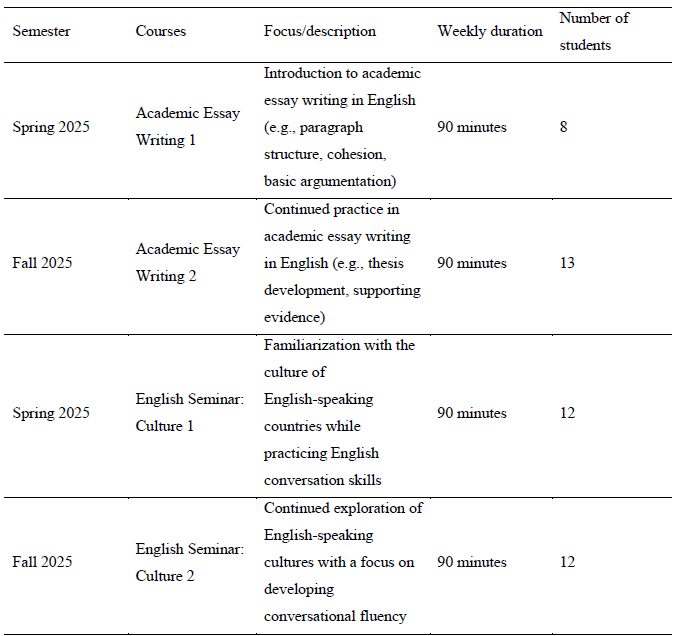
Note. Across all four classes, students’ English proficiency ranged from CEFR A2 to B2.
In the seminar classes, students became familiarized with the cultures of English‑speaking countries while practicing their English conversation skills. They were required to give presentations either in group or individually and engage in conversations with peers. In the writing classes, students explored how to write academic essays in English, including aspects such as organization, cohesion, and the development of arguments.
AI‑mediated learning activities
Over two semesters in the academic year 2025, we integrated ChatGPT into speaking and essay‑writing activities (Figure 1). Essay writing activities included describing a memorable childhood experience and describing a successful person students know. In the writing classes, students used ChatGPT to generate topic ideas and mind maps with prompts provided by the instructor, co‑constructing an outline with ChatGPT with peers, and drafting and revising their essays while requesting language‑focused feedback (e.g., grammar, cohesion, and lexical variety) from the tool.
In the seminar courses, students also used ChatGPT for oral‑communication‑oriented tasks. These tasks included presentations on introduction to famous places and discussing culture-related topics in pairs and groups. For each weekly cultural theme, the cycle involved pre‑task instruction on target expressions and background information, individual practice in which students engaged in short text‑based dialogues with ChatGPT (e.g., practicing role‑plays, asking follow‑up questions, or requesting pronunciation tips and example sentences), and small‑group discussion in class to share their experiences of interacting with ChatGPT and to compare AI‑mediated and human‑to‑human communication.
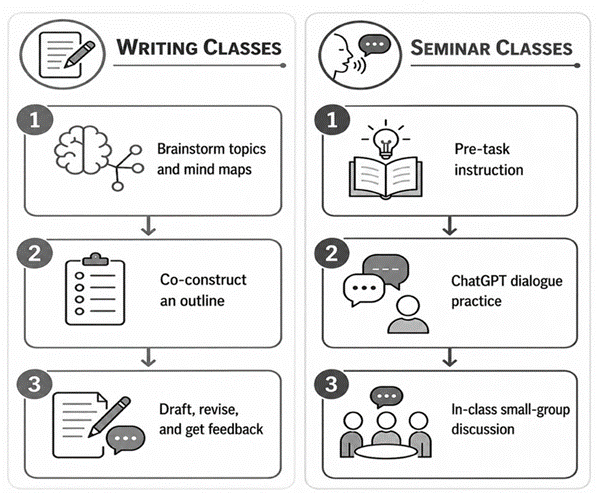
Figure 1. Integration of ChatGPT in Writing and Speaking Activities
After each AI‑mediated activity, students completed a brief written reflection on the perceived benefits and challenges of using ChatGPT. All students were instructed to keep copied transcripts or screenshots of selected interactions. In total, 24 logs were collected across the four classes. Before these activities, the first author conducted a 15‑minute orientation in which she demonstrated how to use ChatGPT, create effective written and oral prompts, and critically evaluate AI‑generated suggestions. Furthermore, the potential benefits (e.g., idea generation, language feedback) and risks (e.g., errors, hallucinated references) were explained and course expectations for responsible use were clarified.
To maintain consistency across the dataset, students were required to use the free, browser‑based version of ChatGPT available during the study period, which provided limited access to GPT-4o. This version was already familiar to many participants and supported both text‑based activities and communicative practice through its voice mode.
In weeks 5–6 of the courses, iterative prompt‑design tasks were introduced to students. They initially submitted a simple prompt to ChatGPT, examined the relevance and accuracy of the response, and then revised their prompt at least once to improve clarity and specificity. In some sessions, students worked in pairs to co‑construct prompts and compare outputs, sharing effective solutions with their peers.
Dataset
The data for this study comprised brief field notes, teaching records, students’ short written reflections and 24 voluntarily selected ChatGPT interaction logs collected across the four classes. The logs were selected to provide illustrative examples of students’ use of ChatGPT in writing and speaking activities. They were analyzed in relation to the field notes and reflections to corroborate and contextualize the recurring themes. In all classes, the first author both taught and observed the lessons. During and immediately after lessons, she maintained brief field notes guided by a simple observation sheet that focused on (a) how students engaged with ChatGPT (e.g., frequency and type of prompts, on‑task/off‑task behavior), (b) visible signs of difficulty or confusion when using the tool, and (c) instances where students adapted their strategies (for example, changing prompts, checking AI output with peers, or switching between Japanese and English).
Data analysis
The first author led the data collection and classroom observations, while the second author contributed to the initial stage of the analysis by reviewing the materials and providing feedback on the emerging interpretation. We analyzed the data set for any evidence of emerging autonomous behavior. First, both authors independently read through all materials to become familiar with the data and wrote brief analytic memos. Next, we conducted an initial round of open coding, marking students’ behaviors related to learner autonomy, specifically looking at any instances of goal setting, strategic use of ChatGPT, emotional responses, and patterns of interaction as autonomy-related concepts while remaining open to other relevant behaviors and nuances that emerged from the data. After comparing and refining our codes, we identified nine recurring patterns of students’ AI use. These patterns were subsequently organized into three broader themes, which are explained in the following section. All the examples reported in the findings of this study are anonymized and no identifying details about individual students or classes are included. Students were informed that classroom activities involving AI might later be used in presentations and publications about this teaching practice, and they consented to the use of anonymized data.
Findings and Discussion
The dataset revealed nine patterns of commonly using ChatGPT by the students. These patterns are associated with different dimensions of autonomy. The findings are discussed below in more detail to illustrate how learner autonomy emerged through recurring patterns in students’ AI use and how these patterns can connect to three broader themes of learner autonomy. Table 2 provides an overview of the number of students demonstrating the use of each pattern and the number of times the pattern emerged in the dataset.
Table 2. Learner Autonomy Patterns Informing the Three Themes in AI‑Supported EFL Classes
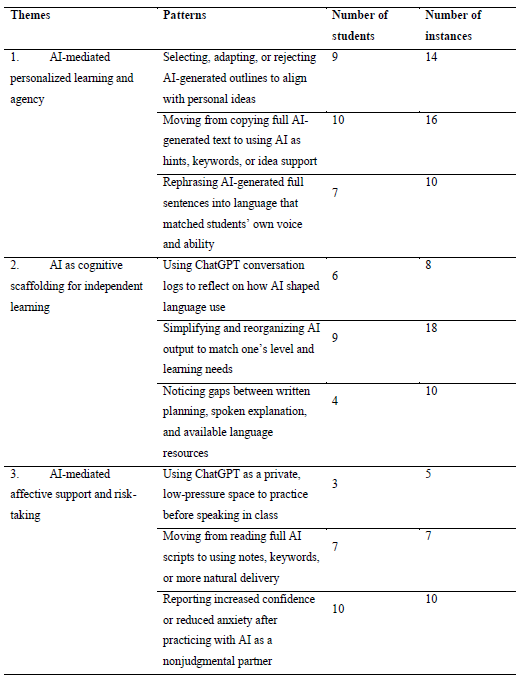
The following sections present examples, quotations, and our interpretations to show how these patterns appeared in practice and how they may have been relevant to each of the three broader themes.
AI-mediated personalized learning and agency
Across the four classes, students appeared to develop agency when they moved from accepting ChatGPT output to selecting, adapting, or rejecting it. In writing tasks, nine students chose and modified AI-generated outlines to match their own ideas when they were asked two essays at two different times about “a memorable childhood experience” or “describing a successful person you know”, while two rejected ChatGPT’s suggestions and used them as a contrast for brainstorming. One learner wrote, “seeing many outlines helped me realize which opinions were really mine and which were only from the AI.” For students who struggled with such personal essay topics, AI-generated examples helped them explore possible angles before choosing perspectives that fit their own experiences. This use of ChatGPT aligns with research on the effectiveness of AI-supported prewriting and idea development (Lee et al., 2025; Moorhouse et al., 2025).
A similar pattern appeared in speaking tasks. Seven students initially generated full-sentence answers with AI and read them aloud word-for-word, which made their delivery sound unnatural and limited spontaneous response. With guidance, they began extracting key ideas, practicing useful phrases, and paraphrasing the content in their own words. These changes suggest a gradual shift from dependence on AI-generated text toward more active and personalized use of AI for learning support.
AI as cognitive scaffolding for independent learning
AI served as cognitive scaffolding when students used it to organize ideas, identify language gaps, and make informed decisions regarding improvement. In seminar classes, six students who maintained ChatGPT conversation logs demonstrated increased metacognitive awareness of the influence of AI on their language use. They mentioned that ChatGPT helped them notice expressions that they could understand in writing but could not easily use in speaking. This finding is significant, as Japanese university EFL students have previously been found to perceive ChatGPT as beneficial while also acknowledging the potential risk of overreliance (Dizon et al., 2025).
The findings from the writing classes also indicated the same trend. For example, a student who experienced challenges with essay organization reported that a ChatGPT-generated outline provided “too many and too difficult” sections yet clarified potential structures. The student subsequently simplified and reorganized the outline to align with her proficiency. She concluded that although ChatGPT gave her many ideas, she had to choose what is possible for her level. Another student practiced articulating her AI-generated outline aloud, which helped her recognize unfamiliar vocabulary and prompted her to understand how to communicate ideas more clearly.
These cases illustrate that students employed AI support selectively, demonstrating the planning, evaluation, revision, and reflection processes central to self-regulated AI-supported writing (Kong et al., 2024). Furthermore, these examples align with the concepts of noticing and pushed output, as students recognized discrepancies between their intended expression and their current linguistic capabilities (Schmidt, 1990; Swain, 1995; Swain & Lapkin, 1995).
AI-mediated affective support and risk-taking
A third dimension of learner autonomy that was evident in the findings was the affective support that AI offered to students who were initially reluctant to speak in front of others. In both seminar classes, many students initially hesitated to participate orally, which partly reflected Japanese classroom norms emphasizing accuracy and the avoidance of public mistakes (Harumi, 2011; King, 2013). However, the students’ interaction logs indicated that ChatGPT-mediated practice outside of class provided some students with a private and low-pressure environment for rehearsal. For example, one shy student who had practiced pronunciation independently with ChatGPT stated, “I could make mistakes without anyone watching.” Over several weeks, this student progressed from rarely volunteering to speak to participating regularly and ultimately leading a short role play. In presentation tasks, several students also transitioned from reading AI-generated scripts to speaking more spontaneously. Three students attributed this shift to reduced anxiety and an increased sense of authenticity. They noted that they were speaking as themselves by using their own voice. These cases indicate that private AI practice may foster risk-taking when students use it beyond reporting AI-generated output to try to personalize language (Zhang et al., 2024).
Integrated Model of AI-Mediated Autonomy
Based on the patterns described above, the authors posit that different uses of ChatGPT complemented one another in ways that supported learner autonomy. In all four classes, students used ChatGPT in generative mode (e.g., text‑based brainstorming, planning, outlining) and in communicative mode (e.g., voice interaction or simulated dialogues for rehearsing explanations and short conversations). Moving between these uses resonates with Paivio’s (1986) dual‑coding theory, which suggests that learning is strengthened when information is processed through more than one channel, such as written and spoken language. When students combined these AI‑mediated modes with opportunities to reflect on their learning, they were better able to monitor their progress, notice gaps in their abilities, and adjust how they used ChatGPT to meet their own needs. Building on these findings, we propose an integrated model of AI‑supported learner autonomy (Figure 1).
In this model, learners move iteratively between generative uses of ChatGPT for planning and idea development and communicative uses for rehearsing and testing those ideas in dialogue. Through ongoing reflection and adaptation, they become aware of gaps in their language use and revise their learning strategies accordingly. Following Benson (2011), Reinders (2010), and Zimmerman (2000), we interpret this reflection‑and‑adjustment cycle as a manifestation of learner autonomy and self‑regulated language learning, insofar as students take increasing charge of their plans, monitoring, and strategic choices.
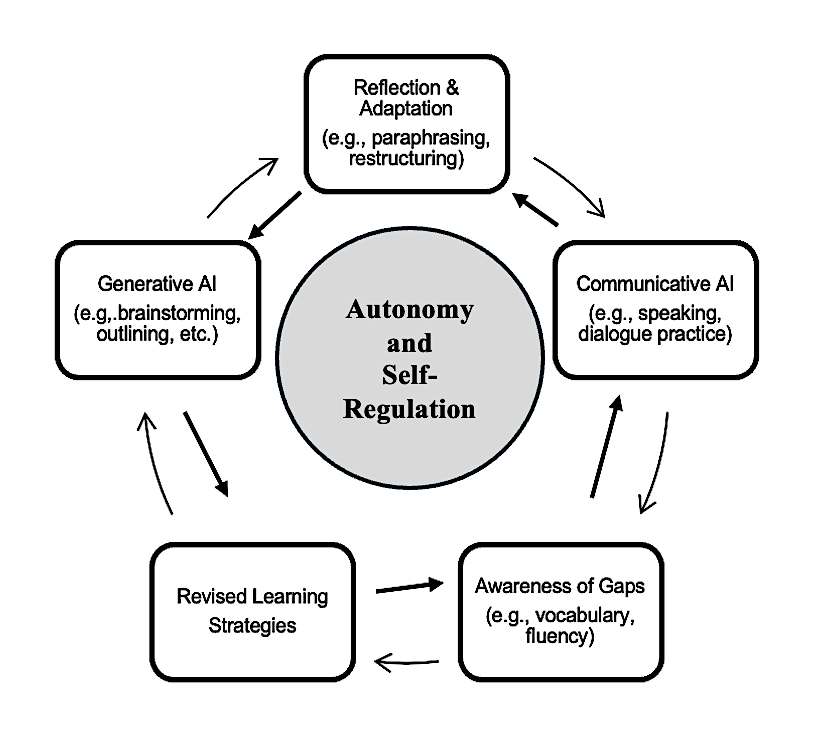
Figure 2. Iterative Learning Cycle Between Generative and Communicative AI
This cyclical pattern highlights how a single AI tool such as ChatGPT can be appropriated both for cognitive support (e.g., idea generation, scaffolding) and for interactional practice (e.g., dialogue rehearsal). In this way, the model extends existing accounts of autonomy in computer-assisted language learning (CALL) by showing how students can connect these functions together within one tool while maintaining agency over how, when, and to what extent they rely on AI.
Translating Findings into Pedagogical Strategies
To foster autonomy in the context of AI, educators need to provide scaffolding strategies to their students that extend beyond technical instruction. Students benefit from such structured opportunities because they can explore and reflect on their use of AI and begin recognizing AI output as a support for their own autonomous learning. Drawing on the study’s findings and recent research in CALL and higher education, several principles are identified that support the cognitive, affective, and interactional dimensions of learner autonomy.
First and foremost, AI use should be addressed explicitly from the outset to enable students to make informed decisions regarding whether, when, and how to utilize tools such as ChatGPT. Research (Gašević et al., 2023; Börekci & Çelik, 2024) indicates that variations in students’ digital skills influence their engagement with AI. Börekci & Çelik (2024) add that while university students with higher levels of digital literacy are more likely to perceive AI tools as useful and easy to use, such perceptions do not always correlate with evidence of deeper or more critically reflective engagement. Such practices underscore the need to design activities that go beyond digital proficiency. Reflective engagement and disciplinary understanding should also be equally emphasized in order to foster autonomy. Therefore, educators should not assume that all students possess the ability to use AI tools effectively or critically. Instead, AI should be integrated into classroom instruction to include prompting strategies, evaluation of AI-generated outputs, and critical reflection on how AI can both support and constrain learning.
Furthermore, AI’s tendency toward template-like phrasing can serve as a pedagogical resource when instructors explicitly contrast AI-generated and human-written texts. Providing students with parallel texts and prompting them to compare features such as sentence structure, coherence, authorial voice, stance, and rhetorical choices can enhance critical reading skills and increase awareness of stylistic differences (Amirjalili et al., 2024). For instance, students may be asked to observe whether AI-generated texts often overuse connectors such as “however” or rely on polished yet impersonal phrasing, and to compare such features with human-written texts that may express the same idea more directly through using phrases such as “I think,” “I feel,” or “I want to argue.” Emphasizing these distinctions can help learners recognize that effective writing is personally meaningful and rhetorically situated. Through this process, students may develop a more authentic academic voice and appreciate individuality as a key aspect of learner autonomy.
Finally, fostering autonomy in AI-supported language education requires both ethical reflection and the establishment of supportive policy frameworks. Classroom activities that prompt students to distinguish between AI-assisted and original components of their writing can promote reflection on authorship and appropriate use. At the institutional level, emerging guidelines for generative AI in higher education emphasize learning and assessment, ethics, and academic integrity (An et al., 2025). Efforts to explain AI affordances and risks, including informal classroom discussions, are consistent with research indicating that transparent, stakeholder-informed policies help maintain learner agency (Chan, 2023). These practices are essential for educators seeking to model autonomy-supportive approaches while integrating AI into language education.
Limitations
This study has several limitations. First and foremost, it draws on a small classroom-based case study conducted in four courses at one private women’s university in Japan. The findings should not, therefore, be generalized to all Japanese EFL learners or AI-supported language-learning settings. Moreover, the analysis presented in this paper relied on field notes, teaching records, student reflections, and ChatGPT interaction logs voluntarily submitted by students. Although these sources provide insight into students’ reported and observable practices, they cannot fully capture learners’ private decision-making processes or longer-term changes in autonomy. Also, because the first author also served as the instructor of the classes where the data for this case study was collected, her interpretations may have been shaped by familiarity with the students and classroom context. Another limitation of the study is that it does not establish causal effects of ChatGPT use on writing, speaking, or learner autonomy. Future research could examine these processes over a longer period within a wider range of institutions and learners to investigate how AI-mediated practice transfers to sustained independent learning and human-to-human communication.
Conclusion
AI has the potential to reshape language learning if educators prompt students to use it as a support tool for students’ skill growth. Autonomy takes shape when students learn to explore with, question, adapt, and reflect on what AI tools produce. We have witnessed students gain confidence when they make AI generated responses their own by comparing outputs with their ideas. In addition, they refined both prompts and outputs to better align with their goals, which in turn, helped them recognize the value of their individual voices. Teachers should guide students by creating space for openness and fostering digital literacy so that they can approach AI with constructive curiosity and responsibility.
Looking ahead, there are important questions we still need to explore. How do cultural expectations and classroom traditions shape the way students respond to AI? Can regular reflection with these tools build lasting habits of self-regulation and critical thinking, or are the effects short-lived? What differences emerge when AI is used in different contexts, whether in EFL classrooms, English as a Medium of Instruction (EMI) settings, or informal learning contexts? These are the kinds of questions future research can address. Of utmost importance, however, is that we continue to recognize the role of AI as a learning partner which can help students find their own voice, take ownership of their learning progress, and engage more deeply with language and ideas.
References
Ahearn, L. M. (2001). Language and agency. Annual Review of Anthropology, 30. 109–137. https://doi.org/10.1146/annurev.anthro.30.1.109
Aoki, N., & Smith, R. C. (1999). Learner autonomy in cultural context: The case of Japan. In S. Cotterall & D. Crabbe (Eds.), Learner autonomy in language learning: Defining the field and effecting change (pp. 19–27). Peter Lang.
Amirjalili, F., Neysani, M., & Nikbakht, A. (2024). Exploring the boundaries of authorship: A comparative analysis of AI-generated text and human academic writing in English literature. Frontiers in Education Digital Learning Innovation, 9. https://doi.org/10.3389/feduc.2024.1347421
An, Y., Yu, J.H., & James, S. (2025). Investigating the higher education institutions’ guidelines and policies regarding the use of generative AI in teaching, learning, research, and administration. International Journal of Educational Technology in Higher Education, 22(10). https://doi.org/10.1186/s41239-025-00507-3
Benson, P. (2013). Teaching and researching: Autonomy in language learning (2nd ed.). Routledge. https://doi.org/10.4324/9781315833767
Biesta, G. (2015). What is education for? On good education, teacher judgment, and educational professionalism. European Journal of Education Research, Development and Policy, 50(1), 75–87. https://doi.org/10.1111/ejed.12109
Börekci, C., & Çelik, Ö. (2024). Exploring the role of digital literacy in university students’ engagement with AI through the technology acceptance model. Sakarya University Journal of Education, 14(Special Issue-AI in Education), 228–249. https://doi.org/10.19126/suje.1468866
Chan, C.K.Y. (2023). A comprehensive AI policy education framework for university teaching and learning. International Journal of Educational Technology in Higher Education, 20(38). https://doi.org/10.1186/s41239-023-00408-3
Chatti, M. A., Jarke, M., & Specht, M. (2010). The 3P learning model. Journal of Educational Technology & Society, 13(4), 74–85. http://www.jstor.org/stable/jeductechsoci.13.4.74
Creswell, J. W., & Poth, C. N. (2018). Qualitative inquiry and research design: Choosing among five approaches (4th ed.). Thousand Oaks, CA: SAGE Publications.
Deci, E. L. and Ryan, R. M. (1985). The general causality orientations scale: Self-determination in personality. Journal of Research in Personality, 19(2), 109–134. https://doi.org/10.1016/0092-6566(85)90023-6
Dizon, G., Gold, J., & Barnes, R. T. (2025). ChatGPT for self-regulated language learning: University English as a foreign language students’ practices and perceptions. Digital Applied Linguistics, 3, 102510. https://doi.org/10.29140/dal.v3.102510
Dwivedi, Y. K., Kshetri, N., Hughes, L., Slade, E., Jeyaraj, A., Kar, A. K., Baabdullah, A. M., Koohang, A., Raghavan, V., Ahuja, M., Albanna, H., Albashrawi, M. A., Al-Busaidi, A. S., Balakrishnan, J., Barlette, Y., Basu, S., Bose, I., Brooks, L., Buhalis, D., & Wright, R. (2023). Opinion Paper: “So what if ChatGPT wrote it?” Multidisciplinary perspectives on opportunities, challenges and implications of generative conversational AI for research, practice and policy. International Journal of Information Management, 71, 102642. https://doi.org/10.1016/j.ijinfomgt.2023.102642
Eaton, S. E. (2023). Postplagiarism: transdisciplinary ethics and integrity in the age of artificial intelligence and neurotechnology. International Journal for Educational Integrity,19 (23). https://doi.org/10.1007/s40979-023-00144-1
Fujii, N. & Hook, I. (2024). ChatGPT and academic writing: A study of Japanese EFL undergraduates. PanSIG Journal, 10(1), 91–98. https://doi.org/10.37546/JALTPanSIGJ10.1-12
Fujii, N. (2025). Generative AI as a writing partner: Ethical integration and reflective practices in higher education. In L. Grausam & G. S. Poole (Eds.), Critical Sociolinguistics in a Modern World, Proceedings of the 1st Kansai Sociolinguistics Colloquium (pp. 14–23). University of Bremen. https://doi.org/10.26092/elib/4762
Gašević, D., Siemens, G. and Sadiq, S. (2023) Empowering learners for the age of artificial intelligence. Computers and Education: Artificial Intelligence, 4, 100130. https://doi.org/10.1016/j.caeai.2023.100130
Godwin-Jones, R. (2019). Riding the digital wilds: Learner autonomy and informal language learning. Language Learning & Technology, 23(1), 8–25. https://doi.org/10.64152/10125/44667
Harumi, S. (2011). Classroom silence: voices from Japanese EFL learners. ELT Journal, 65(3), 260–269. https://doi.org/10.1093/elt/ccq046
Hockly, N. (2023). Artificial intelligence in English language teaching: The good, the bad and the ugly. RELC Journal, 54(2), 445–451. https://doi.org/10.1177/00336882231168504
King, J. (2013) Silence in the second language classrooms of Japanese universities. Applied Linguistics, 34(3), 325–343. https://doi.org/10.1093/applin/ams043
Kohnke, L., Moorhouse, B. L., & Zou, D. (2023). ChatGPT for language teaching and learning. RELC Journal, 54(2), 537–550. https://doi.org/10.1177/00336882231162868
Kong, S.-C., Lee, J. C.-K., & Tsang, O. (2024). A pedagogical design for self-regulated learning in academic writing using text-based generative artificial intelligence tools: 6-P pedagogy of plan, prompt, preview, produce, peer-review, portfolio-tracking. Research and Practice in Technology Enhanced Learning, 19, 030. https://doi.org/10.58459/rptel.2024.19030
Krashen, S. D. (1982). Principles and practice in second language acquisition. Oxford: Pergamon Press.
Lee, Y.-J., Davis, R. O., & Choi, J.-I. (2025). Integrating generative AI into EFL writing: University students’ strategies and perceptions. Online Journal of Communication and Media Technologies, 15(4), e202541. https://doi.org/10.30935/ojcmt/17545
Little, D. (2007). Language learner autonomy: Some fundamental considerations revisited. Innovation in Language Learning and Teaching, 1(1), 14–29. https://doi.org/10.2167/illt040.0
Long, M. H. (1996). The role of the linguistic environment in second language acquisition. In W. C. Ritchie, & T. K. Bhatia (Eds.), Handbook of second language acquisition (pp. 413–468). Academic Press.
Lyster, R., & Ranta, L. (1997). Corrective feedback and learner uptake: Negotiation of form incommunicative classrooms. Studies in Second Language Acquisition, 19(1), 37–66. https://doi.org/10.1017/S0272263197001034
Mercer, S. (2011). Understanding learner agency as a complex dynamic system. System, 39, 427–436. https://doi.org/10.1016/J.SYSTEM.2011.08.001
Merino-Campos, C. (2025). The impact of artificial intelligence on personalized learning in higher education: A systematic review. Trends in Higher Education, 4(2), 17. https://doi.org/10.3390/higheredu4020017
Moorhouse, B. L., Wan, Y., Wu, C., Wu, M., & Ho, T. Y. (2025). Generative AI tools and empowerment in L2 academic writing. System, 133, 103779. https://doi.org/10.1016/j.system.2025.103779
Nakata, Y. (2011). Teachers’ readiness for promoting learner autonomy: A study of Japanese EFL high school teachers. Teaching and Teacher Education, 27, 900–910. https://doi.org/10.1016/j.tate.2011.03.001
Paivio, A. (1986). Mental representations: A dual coding approach. Oxford University Press.
Reinders, H. (2010). Towards a classroom pedagogy for learner autonomy: a framework of independent language learning skills. The Australian Journal of Teacher Education. 35(5). 40–55. https://doi.org/10.14221/ajte.2010v35n5.4
Ryan, R. M., Deci, E. L. (2018). Self-determination theory: Basic psychological needs in motivation, development, and wellness. United Kingdom: Guilford Publications. https://doi.org/10.1521/978.14625/28806
Schmidt, R. (1990). The role of consciousness in second language learning. Applied Linguistics, 11(2), 129–158. https://doi.org/10.1093/applin/11.2.129
Selinker, L. (1972). Interlanguage. International Review of Applied Linguistics in Language Teaching, 10(1-4), 209–232. https://doi.org/10.1515/iral.1972.10.1-4.209
Swain, M. (1995). Three functions of output in second language learning. In G. Cook & B. Seidlhofer (Eds.), Principle and practice in applied linguistics: Studies in honour of H. G. Widdowson (pp. 125–144). Oxford University Press.
Swain, M., & Lapkin, S. (1995). Problems in output and the cognitive processes they generate: A Step towards second language learning. Applied Linguistics, 16(3), 371–391. https://doi.org/10.1093/applin/16.3.371
Sweller, J. (1988). Cognitive load during problem solving: Effects on learning. Cognitive Science, 12(2), 257–285. https://doi.org/10.1207/s15516709cog1202_4
Szabó, F, & Szoke, J. (2024). How does generative AI promote autonomy and inclusivity in language teaching? ELT Journal, 78(4), 478–488. https://doi.org/10.1093/elt/ccae052
van Lier, L. (2008). Agency in the classroom. In J. P. Lantolf, & M. E. Poehner (Eds.), Sociocultural Theory and the Teaching of Second Languages. London: Equinox.
Vygotsky, L. S. (1978). Mind in society: Development of higher psychological processes (M. Cole, V. Jolm-Steiner, S. Scribner, & E. Souberman, Eds.). Harvard University Press. https://doi.org/10.2307/j.ctvjf9vz4
Zhai, C., & Wibowo, S. (2023). A systematic review on artificial intelligence dialogue systems for enhancing English as foreign language students’ interactional competence in the university. Computers and Education: Artificial Intelligence, 4, 100134.
https://doi.org/10.1016/j.caeai.2023.100134
Zhai, X., Nyaaba, M. & Ma, W. (2025). Can generative AI and ChatGPT outperform humans on cognitive-demanding problem-solving tasks in science? Science & Education, 34, 649–670. https://doi.org/10.1007/s11191-024-00496-1
Zhang, C., Meng, Y., & Ma, X. (2024). Artificial intelligence in EFL speaking: Impact on enjoyment, anxiety, and willingness to communicate. System, 121, 103259. https://doi.org/10.1016/j.system.2024.103259
Zimmerman, B. J. (2000). Attaining self-regulation. Handbook of Self-Regulation, 13–39. https://doi.org/10.1016/b978-012109890-2/50031-7
I found this article insightful in the way that it approaches the use of AI in the classroom from a learner autonomy perspective. In my experience, some students have quickly adapted AI to their own learning goals by experimenting with it outside the classroom, but other students are still struggling to use it in ways that further their learning, rather than relying on it as “answer provider.” You rightly point out that students need instruction on how to use AI in reflective and purposeful ways. I particularly appreciate the idea that student overreliance on AI should be treated as a learner autonomy development issue, rather than a misconduct issue. I think this is especially important given that students navigate varied expectations, communicated (or not) in various ways, about AI use for class work.
I would be interested to learn more details about the instructions about AI that were given in the classes, particularly the 15-minute orientation. In addition, because Table 2 indicates that students did at times submit AI-output without editing, I would be interested to know if the students were explicitly told that they could not do this, and if so, how violations were dealt with in the classroom context. How was the idea of learner autonomy development implemented in these cases?
One minor point that I am confused about is in the section “AI as cognitive scaffolding for independent learning.” You wrote, “They mentioned that ChatGPT helped them notice expressions that they could understand in writing but could not easily use in speaking. This finding is significant, as Japanese university EFL students have previously been found to perceive ChatGPT as beneficial while also acknowledging the potential risk of overreliance (Dizon et al., 2025).” I would appreciate further explanation of how the cited study relates to your results.
Finally, I appreciate the pedagogical strategies you suggest. Going beyond the scope of your article, I wonder about the cultural assumptions behind the direct writing style that you state is a mark of human-written text.
Thank you for emphasizing the importance of teaching students AI ethics and giving them clear guidance on AI usage policies.