Diego Mideros, The University of the West Indies, Trinidad & Tobago
Abstract
This paper illustrates the process of analyzing student digital footprints from a Learning Management System (LMS) to understand student engagement and autonomy. In online and blended courses, an LMS such as Moodle records student activity and makes it available as activity reports, both individual and collective. Such reports provide objective course data about the learning resources that students interact with and when they complete concrete tasks. Student activity reports are an invaluable resource for investigating student engagement, particularly in online/blended environments where students are required to engage in independent, out-of-class learning. However, despite their objectivity, it is difficult to interpret them from a qualitative standpoint. The solution I propose is to construct narratives from individual reports. Short narratives can be drafted describing the students’ course trajectories from beginning to end based on these reports. This data comes from a large-scale study conducted at a university in the English-speaking Caribbean involving students taking a compulsory, credit-bearing Spanish language course. At the end of the paper, I present some preliminary findings from 260 reports I have drafted as descriptive narratives to explore student autonomy through evidence-based analysis of student engagement.
Keywords: student autonomy, student engagement, narratives, blended learning, independent/out-of-class learning
The rise of online and blended approaches to teaching and learning in formal education requires greater levels of responsibility and commitment to the learning process on the part of students. In other words, students are required to exercise more autonomy when it comes to learning beyond the classroom. In online and blended learning, the use of Learning Management Systems (LMS) like Moodle is standard, as students are expected to actively engage with learning resources and activities designed for independent, out-of-class learning as part of the course. Moodle is an LMS that beyond hosting course materials, also records student activity, creating a digital footprint. This footprint provides objective data on student engagement.
In this paper, I illustrate my approach to analyzing student digital footprints as evidence-based data of their engagement. In my research of student autonomy in formal settings (Mideros, 2018; 2021), I have attempted to look for evidence of students’ actions and active engagement with their language learning to further investigate and understand autonomy as a universal (Little, 1999) and enacted phenomenon (Murray et al., 2014). I use student autonomy as a synonym of learner autonomy simply because my explorations have been with university students taking formal credit-bearing language courses.
The present study is part of a large-scale project where I investigate student autonomy in a compulsory, credit-bearing, Spanish language blended course at a university in the English-speaking Caribbean. The data for this study comes from surveys, in-depth interviews with students, and the analysis of student activity reports spanning three academic years and six cohorts of students. However, this paper focuses on the analysis of student activity reports for the second semester of the 2024-2025 academic year. Through the analysis of this subset of data, I seek to illustrate how I went about analyzing the data available on Moodle.
The activity reports available on Moodle are straightforward; they present information with a list of entries of the dates and times when students view resources and complete activities. This information is also downloadable in spreadsheet format. In my study, it is relevant to know what students do in terms of engagement with the materials and the activities and when they do it. However, analyzing this information qualitatively represents a challenge for me; hence, in this paper I provide examples of how I ‘narrativized’ these reports configuring individual descriptions attempting to draft students’ trajectories.
For the remainder of the paper, I will attempt to take a narrative approach recounting the story of my course, the way I designed it, and how I envisioned students ideally engaging with it. I will explain my take on autonomy and how the construct of engagement became instrumental in my exploration of student autonomy. I will then present three stories as examples of my approach to analyzing student digital footprints.
My Course, My Story
My story takes place at a regional university in the English-speaking Caribbean. I work at the university’s language learning center where I teach and coordinate the Spanish language courses. In the academic year 2022-2023, my university implemented a foreign language policy for all new students in all degree programs. The policy states that students without formal secondary school qualifications in a foreign language are required to take a credit-bearing foreign language course.
Course design
In preparation for the implementation of the new policy, with my colleagues in other languages—French, Japanese, and Mandarin Chinese—we were instructed that our courses should take a blended format. This decision was administrative and directly linked to the number of credits the new courses needed for university approval. Undergraduate courses at my institution normally carry three credits, which are calculated against the number of contact hours. For the new courses to meet the three-credit standard with the human resources available, it was necessary to design an online component requiring minimal teacher intervention. The online component of our blended courses had to comprise mostly self-access resources for students to engage in independent, out-of-class learning and self-correcting activities. The self-paced element of our new courses was particularly relevant, as enrolment for the courses was expected to be high. Most students in faculties outside of Humanities would need to take these courses, and monitoring student online activity adds a great deal to teachers’ workload.
As students are expected to exercise a higher degree of independent learning in the online segment of the blended courses, I found it important to explore their engagement as a way to further understand autonomy.
The new courses had a clear structure framed within university standards: 12 weeks of teaching, six weekly contact hours divided into two separate two-hour in-person classes, and two hours of independent, out-of-class learning on the LMS. In terms of language, since all students are supposed to be beginners, course content and delivery should aim to bring students to a solid A1 Common European Framework of Reference for Languages level (CEFR). Therefore, the courses should be content-rich to help students develop a practical, foundational language competency.
I designed a beginner Spanish language course to meet the standards agreed upon in my center. Our language courses are based on textbooks from well-established international publishers specializing in language courses indexed against CEFR levels. The textbook I use contains nine thematic units and its goal is to take learners to achieve an A1 level of language proficiency. The 12-week semester traditionally has two in-class testing periods, one halfway through the semester and the next one at the end. Each test assesses the four communicative language skills: reading, writing, speaking, and listening. I adapted the curriculum for the course attempting to cover one full textbook unit per week. Realistically, we can cover eight of the nine textbook units during the semester. We cover the first four units in the first half of the semester before the midterm testing period. For the second half of the semester, we cover four more units before the final testing period.
It was the first time that we would incorporate an online component into our courses. My main concern while designing the online materials and activities was that they should account for approximately two hours of independent work on a weekly basis. The online segment should not be perceived as extra work, nor should it be perceived as filler activities. Even more important to me was the research potential I saw to continue investigating student autonomy in a situation where students are required to engage in learning beyond the classroom.
The online materials
I decided to incorporate basic principles of the flipped classroom approach (Qi et al., 2024), which takes theory out of the classroom for students to study it independently ideally before in-person classes, while class time is devoted to practice and application. I took the core grammatical elements of each unit and recorded short video lessons where I explain basic grammar and vocabulary for each unit. I first prepared the slides with all the information I took directly from the textbook with additional examples. I provided a translation into English since the textbook is entirely in Spanish. I attempted to produce short and straightforward videos explaining the concepts in English with clear examples in Spanish. I then recorded shorter videos for each unit, varying from three to six videos lasting four to six minutes maximum each. The number of videos per unit and the length depended on the complexity of the topics.
For each unit, students have access to the video lessons and the slides. The video lessons are all hosted on YouTube and linked to Moodle. By sharing both videos and slides, students could have a choice depending on their learning style. The slides in Spanish with English translations cater to students who are more comfortable reading, while the video lessons can be more suitable for auditory learners. Furthermore, YouTube gives students the possibility of adjusting the video speed, as well as using captions and subtitles. The goal was for students to engage in out-of-class learning with materials that are accessible and friendly. From the beginning of the course, I explicitly encourage students to either view the video lessons, read the slides, or both before class. I state this clearly in the course outline and reiterate it on a weekly basis in every class and in the Moodle announcements forum.
The online activities
I adapted all the online activities from the workbook available at the back of the textbook. I converted the workbook activities to self-correcting exercises in the form of multiple choice, true/false, and drag-and-drop. By adapting activities directly taken from the textbook, I ensured that all the content of the course was coherent. The activities cover grammar, vocabulary, reading, listening, and culture. I created eight to ten short activities, each activity containing a maximum of ten items for each unit.
The ideal online approach encouraged students to view the videos and/or the slides before class and complete the online activities at the end of the week, after the in-person classes, reinforcing what they had studied in the videos and in person. However, there are no strict deadlines. All materials and activities are available to students throughout the semester, and they are encouraged to engage with the materials and complete the activities as many times as they wish. I also ensured the system would only show the correct answers, without highlighting or hinting at the correct answer for incorrect items. This was a way of encouraging students to repeat the activities to try to figure out what had gone wrong in previous attempts.
The LMS is easily accessible from any device (laptops, desktops, tablets, or smartphones), students can access all materials and activities on the go as long as they have internet access; they can also download the slides to read offline. Flexibility and frequent gentle reminders are key elements of the course, designed to encourage students to engage in out-of-class, independent learning. I only close activities at the end of the semester, after giving students ample notice.
The online activities account for 10 percent of the grade for the course. The Moodle system adds up the scores, and at the end of the semester, I download the spreadsheet the system produces with each student’s scores. Viewing the video lessons or reading the slides carries no marks.
My students
For the second semester of 2024-2025, 272 students registered for the course, and for this paper, I analyzed 260 reports. I excluded the remaining 12 reports because those students abandoned the course without deregistering, making their data irrelevant for this study. The students enrolled in my course come from all faculties in the university, namely Engineering, Food and Agriculture, Humanities and Education, Law, Science and Technology, and Social Sciences.
All students in these six faculties come from a variety of undergraduate majors and are predominantly in their first year, although they can complete the course at any point during their degrees. The cohort includes both male and female students from diverse age groups. While specific demographic characteristics are relevant to the larger study’s analysis, a detailed discussion of them is beyond the scope of this paper.
My primary objective here is to illustrate my process of interpreting the data by constructing short descriptive narrative accounts. Therefore, in the interest of space and clarity, I will present only a selection of preliminary, emerging findings. These serve as an illustrative example of my narrative approach to the data. The full findings will be disseminated in future research papers and other publications.
My Research on Student Autonomy
I have been researching student autonomy in formal university settings for over a decade (Mideros & Carter, 2014; Mideros, 2018; 2021). I began researching specialist Spanish majors and I am now researching non-specialist Spanish students. Since I embarked on my exploration, I have been following Little’s (1999) recommendation that
…our research effort, both theoretical and empirical, should centrally concern itself with firstly autonomy as a general human behavioural capacity—what it is, where it comes from, how it develops, and so on—and secondly the relation between social knowledge systems and the discourse by which learning is mediated (p. 17).
Therefore, my investigation of autonomy seeks to observe student behaviors that may suggest that they are exercising their human capacity for autonomy and taking responsibility for their language learning. Similarly, Holliday’s (2003) notion of social autonomy establishes that there are cultural ways of being autonomous in every culture, students in different cultures can act autonomously depending on what autonomy looks like in their contexts.
My research in the English-speaking Caribbean, concretely Trinidad and Tobago, suggests that formal assessment plays a pervasive role in student autonomy (Mideros, 2018; 2021) because students’ focus is on performing well in formal examinations rather than on language learning per se. I see autonomy as a matter of student approach and how students approach their formal language studies. This is based on the approaches to studying framework in university undergraduate courses (Entwistle, 2009), which proposes three distinctive approaches: deep, surface, and strategic. The deep approach, which in my view is the most consistent with autonomy, is where students approach studying with an effort to understand the subject matter in great depth. The surface approach lies at the opposite side of the spectrum, where students approach the subject matter superficially, attempting the bare minimum to pass and/or avoid failure. The third is the strategic approach, a combination of both deep and surface. In the strategic approach, students employ concerted study methods and strategies not necessarily because they want to gain a deep understanding of the subject matter, but because they seek to attain the best possible results (Entwistle, 2009). In my research, I have found that students in my context tend to be strategic, which is a result of a heavy exam-driven culture where students are often educationally socialized to perform well in exams. Therefore, the social form of autonomy (Holliday, 2003) I have identified in my research tends to be a strategic form of autonomy where students’ efforts are focused on academic performance.
For this study, I follow the literature on learning beyond the classroom (LBC) (e.g., Reinders & Benson, 2017; Reinders, 2020), particularly Reinders’ (2020) framework for LBC. This framework comprises four clear dimensions for the planning, implementation, and assessment of any LBC effort: location, formality, pedagogy, and control. Location refers to where learning takes place. In this study, this includes both the classroom and the LMS; however, the focus of this study is on what students do on the LMS. Formality relates to whether learning is linked to formal qualifications. In my students’ case, they receive academic credits for the course. Pedagogy refers to instruction and whether there is instruction or not. In my course, there is explicit instruction as well as guidance on what students are required to do beyond the classroom. Control refers to how much choice students have during the learning process. In my study, students can choose when, where, and how they access and complete the online materials and activities. The online segment of the course is self-paced, and students can choose between the videos or the slides, as well as when they wish to complete the activities. Both the videos and the activities are short so that students can break their learning tasks into smaller and manageable parts.
Alongside my view of autonomy as a matter of student approach, I also associate autonomy with taking an active role in one’s learning. This view is similar to that of Murray et al. (2014) for whom “autonomy is an enacted phenomenon encompassing a network of practices” (p. 97). They argue that Holec’s (1981) definition of autonomy as “the ability to take charge of one’s learning” (p. 3)“ has remained so robust over the years is because he explains autonomy in terms of what autonomous learners do (Murray et al., p. 97).
Engagement
Recently, I came across the construct of engagement (Hiver et al. 2021; 2024), which I find useful for my exploration of autonomy. I am still in the early stages of my understanding of this construct, but it seems to me that an autonomous learner must be an engaged learner. My working assumption is that if a student displays a high level of engagement, that student might be an autonomous learner or, at least, might be in a good position to develop and exercise autonomy.
Action is at the core of student engagement. Hiver et al. (2024, p. 202) posit that “[e]ngagement defines all learning. Learning requires active involvement on the part of the learner, and action is the defining characteristic of learner engagement.” This strong emphasis on action aligns closely with my view of autonomy as an enacted phenomenon (Murray et al., 2014), where students actively take charge of their learning.
Hiver et al. (2024) identify key characteristics of engagement. First, they argue it is action-oriented since learners must be actively involved, physically and/or mentally, to achieve a goal, as engagement is goal- and purpose-driven. A second characteristic is its context-dependent nature; engagement can emerge from situated practices, particularly within formal school settings and their cultural dynamics. The situated nature of engagement implies that engagement typically has an object; learners are usually engaged with specific learning topics, situations, activities, or tasks.
According to Hiver et al., (2024), engagement has four dimensions in language learning: behavioral, cognitive, emotional, and social. Behavioral engagement refers to how actively learners participate in learning activities. Cognitive engagement refers to the mental efforts, and the level of attention learners pay at particular activities and tasks. Emotional engagement refers to the affective reactions, positive or negative, that learners display toward learning activities. Social engagement refers to the kind of interaction and relations that learners exhibit in their communities.
In the early literature on engagement, the concepts of procedural and substantive engagement (Nystrand & Gamoran, 1991) are pertinent to my study and resonate with the notions of deep, strategic, and surface approaches to learning (Entwistle, 2009). Procedural engagement refers to what students have to do as part of a course, where they “competently go through the motions of school” (Nystrand & Gamoran, 1991, p. 262). Substantive engagement, by contrast, is what is required to excel academically: “it requires sustained commitment to and engagement in the content of schooling” (p. 262). Here, the key term is sustained commitment, which is the opposite of last-minute cramming.
My Approach to Narrativizing Student Engagement and Autonomy
My difficulty interpreting the student activity reports stemmed from the fact that I was faced with a list of entries that, on their own, were not qualitatively informative. I figured a useful strategy would be to write short descriptions of what I saw that students had done during the semester as I reviewed the entries. It was then that I realized my descriptions looked like short narratives of students’ trajectories through the online segment of the course. This realization became an ‘aha’ moment, prompting me to incorporate a narrative approach into my analysis.
Narrative inquiry is “[t]he branch of qualitative research that has as its primary concern the stories people tell of their life experiences. … Narrative inquiry attempts to understand the meaning teachers and learners make of their lived (as well as imagined) experiences” (Barkhuizen, 2022, p. 3). In my study, students are not telling me their stories directly. Instead, what the LMS platform provides is their digital footprints, which gives me information of when they began to engage with the course, when they were most active or inactive, when they finished the course, and the outcome. As a teacher-researcher, my role is to draft these descriptions from the objective activity reports and imagine the ways in which students engaged with my course based on my interactions with students and what I have observed in the classroom.
Although I am composing these narrative descriptions based on my students’ digital footprints, I believe that they potentially meet the six characteristics Barkhuizen (2018, p. 112) identifies for a story to be a story. First, stories should “narrate experiences from the past or imagined future.” In my study, this means my narration of what each student did according to the system. Second, stories should “include reflective or evaluative commentary on those experiences.” This lies at the core of my methodological aim, as I analyze and interpret how my students engaged with the course both online and in my classroom observations. Third, stories should “typically have a temporal dimension.” In my narratives, this is provided by the 12-week duration of the course and what students did within that timeframe. Fourth, stories should “embody ‘action’,” which is a key dimension in my study, as I closely examine what students did, which is the primary data for understanding their engagement and autonomy. Fifth, the “action takes place in a social context.” Here, that context is the course’s LMS and the classroom course itself. And sixth, stories “always make references to who was involved in the story, when the action took place, and where it happened” (emphasis in original). Accordingly, my narratives specify who was involved (my students), when the action took place (their periods of engagement and activity), and where it happened (the platform).
Preliminary Analysis and Narrative Drafts
Narrativizing activity reports
In Figures 1. and 2., I present examples of the activity reports generated by the platform for the first two course units for the same anonymous student. The reports are formatted as a list. The column to the left lists course items and their associated activities. The column in the middle shows either the number of views for each item or the grade attained for individual graded activities. The column to the right records the dates when students viewed the items and completed the activities.
Barkhuizen (2022) reminds us that stories “are not merely a list of facts about the things we do, the people we do them with, where and when we do them, they also embody our understandings of those events as well as express our feelings about them” (p. 7). The platform presents information in a list format, which is precisely such a reduced list of facts about what students did and when. My task, therefore, is to embed evaluative commentary to transform these factual lists into coherent narrative descriptions and make sense of them. My evaluative comments come from my interaction with the students in the classroom and my observations.
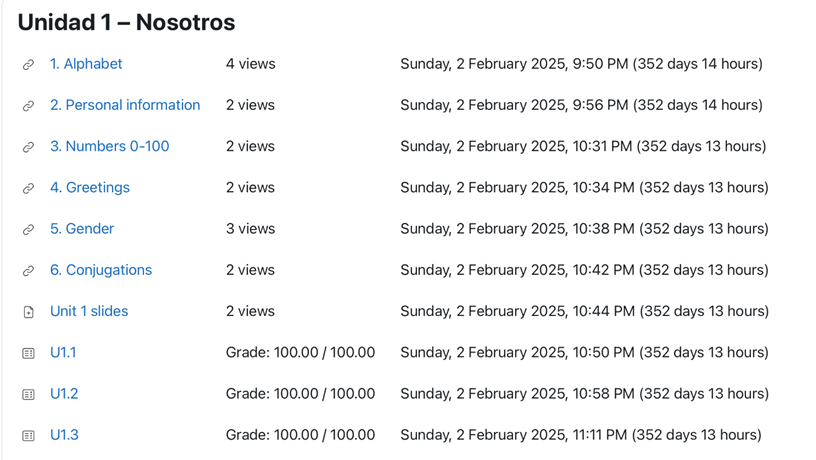
Figure 1. Example of an individual activity report for unit 1
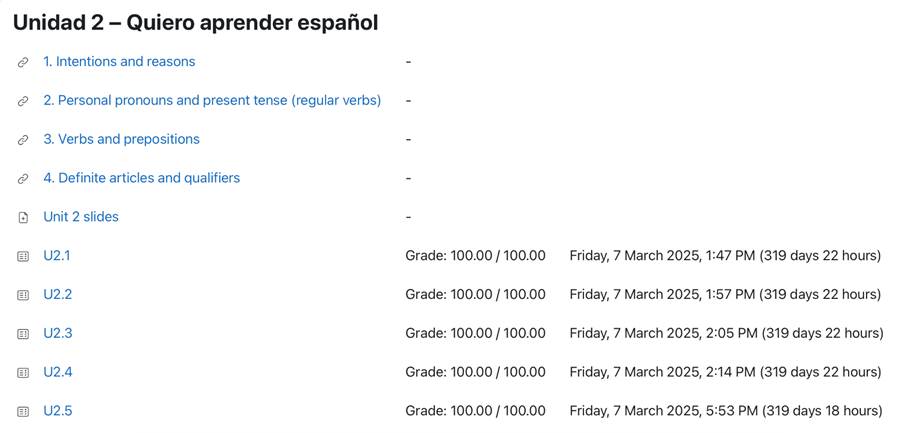
Figure 2. Example of an individual activity report for unit 2
At first sight and using the information of Figures 1. and 2., I can draft a few descriptive and evaluative comments, which serve as the beginning of the narrativization process:
It looks like the student began the course with some impetus. They viewed all the items for the first unit on Sunday, February 2nd. The student looked at all video lessons as well as the slides. The student also completed the activities the same day. For the second unit of the course, the student did not look at any of the videos nor the slides. However, the student completed the activities on March 7th. I see a gap between the completion of the activities for unit 1 and 2, from February 2nd to March 7th, a gap of over a month, which seems to indicate that the student began with impetus to engage with the course, but the momentum only lasted for the beginning of the semester.
This is a simple example of how I analyzed 260 individual student activity reports, looking at what students did and when for each of the units of the course. I identified different levels of engagement based on the activities that students completed and when they completed them, which led me to develop a color-coding system. My color-coding uses a spectrum that goes from green for students who appear engaged, to yellow for those with moderate engagement, to red for students who appear poorly engaged or disengaged.
Engaged students
Students whose narrative descriptions I highlighted with green were students who completed all activities throughout the semester. They looked at the videos and the slides and completed the weekly activities. These were students who did not lose momentum and were able to keep up with a sustained studying routine on a weekly basis. These were the easiest descriptions to construct because it was like a checklist where all boxes are checked. The following is an example of one of those ideal narratives describing the actions of an engaged student:
This student was engaged from the very beginning of the course. From week 1, the student looked at the videos and the slides and then completed all activities. Week after week, the student displayed the same pattern as though a weekly learning or study routine had been developed, and the student was able to sustain it throughout the semester. At no point during the semester, this student let the work pile up.
My evaluative commentary is straightforward because it is an ideal trajectory (I wish all the descriptions were like this, but that is unrealistic). The weekly and sustained engagement could possibly be linked to substantive engagement (Nystrand & Gamoran, 1991), as well as cognitive and affective engagement (Sang & Hiver, 2021). I infer that the student engaged mentally with the material and the weekly sustained engagement suggests a positive attitude to the course. My inference is that this student developed a weekly plan and was able to execute it and stick to it, which are signs of enacted autonomy (Murray et al., 2014).
Moderate engagement
Students whose narratives I highlighted with yellow were students who displayed irregular engagement patterns. Some could be students who started strong and then halfway through the semester neglected Spanish because other courses took priority; therefore, not much activity was recorded on the LMS. However, these students got back to the course and attempted to finish. Others could be students who might have been active throughout the semester, but their activity did not record them looking at all videos and slides. They still looked at some of the videos, and they completed the activities throughout the semester, even if it was not on a weekly basis. There is a sense of incompleteness with these students, which also includes students who did not look at either the videos or the slides but completed all activities weekly or throughout the semester. The following is an example:
This student began the semester by looking at two out of the five videos for unit 1 and the slides, and completed all activities that same week, on January 25th. Week 2 followed a similar pattern for the videos and the slides. The student completed the activities for unit 2 on February 17th. From week 3 through the end, there is a clear pattern: the student looked at the slides weekly but did not look at the videos. The student completed the activities for Units 3, 4, 5, and 6 on March 15th and 17th, and the activities for Units 7 and 8 on March 31st.
My evaluative commentary of a narrative like this is that this student displays signs of procedural engagement (Nystrand & Gamoran, 1991), in other words, this student engages because it is mandatory. The behavioral engagement of letting some of the activities pile up and completing them in chunks raises questions about cognitive engagement in terms of the “deliberate, sustained attention and expend mental effort to achieve learning goals” (Sang & Hiver, 2021, p. 21). The learning goals of students who attempt to complete four weeks’ worth of work in two days come into question.
Disengaged students
Students whose narratives I highlighted with red consisted of two types. The first type were students who did not look at the videos or slides (or looked at very few) but completed the activities in large chunks just before the deadline. The second type were students who simply did not look at the materials and did not complete the activities at all. The following is an example:
Even though this student performed well overall based on the final grade attained, the level of engagement in the online work is questionable. The student only looked at the full content for Unit 2, the slides for Units 1 and 4, and the study guides before tests. No other materials were viewed for the remaining units. Regarding the online activities, the student completed the activities for Unit 1 on March 24th and the activities for Units 2 to 8 on April 4th and 6th. In other words, the student completed all activities in a concentrated period at the very end of the semester.
My evaluative commentary of a narrative like this is that this narrative exemplifies the strategic and surface approaches to studying (Entwistle, 2009) and procedural engagement (Nystrand & Gamoran, 1991), where students engage superficially, primarily with activities that carry marks, as their main goal is to perform well in the course or to avoid failure. The description above shows that the student did indeed perform well overall, despite questionable online engagement. The student barely consulted the learning materials during the semester and instead, in two days at the very end, completed the compulsory activities that would ensure marks. This is not ideal, as it is not the kind of engagement that leads to meaningful learning. In fact, it is the opposite of the sustained and substantive engagement advocated by Nystrand & Gamoran (1991).
Concluding remarks
In this paper, I have illustrated my attempt to analyze student activity reports, which typically present information in a list format with factual entries. While this data is vital for investigating student engagement, it can be difficult to analyze and interpret qualitatively. I have described my process of narrativizing these reports to make sense of student engagement and identify signs of autonomy.
By drafting 260 narratives from my analysis of individual student activity reports, I developed a color-coding process that revealed three distinct kinds of engagement. In cases where I found engaged students, it seemed that students had developed study routines, engaging with both the learning materials and the activities on a weekly basis. ‘When’ students complete online activities in blended courses is of prime importance because it signals either procedural or substantive engagement (Nystrand & Gamoran, 1991). Students who exhibit the sustained commitment characteristic of substantive engagement also appear to exercise a form of autonomy. When students demonstrate that they can commit to learning weekly, I infer that they had an initial plan, executed it and adhered to that study schedule. The moderately engaged and disengaged groups both display signs of primarily procedural engagement, with irregular patterns. In the case of moderately engaged students, one pattern I identified by interacting with them in class is that they begin the course with the intention to engage and commit; however, halfway through the semester, the core courses of their majors often take priority over Spanish. Disengaged students, by contrast, engaged with the course only at the very end of the semester to complete activities at the last minute.
At this stage of my study, I have not yet quantified the number of students in each group. However, I discovered that engaged and autonomous students, while a minority, are not as few as I initially imagined.
Methodologically, my narrative approach has the limitation of being time-consuming and tedious. However, it is a qualitative way of making sense of factual lists that contain valuable, objective information. In the future, I would discuss these reports with students, an opportunity that was not feasible for this project given the large amount of data I have collected for this study.
The pedagogical implications of these preliminary results are linked to fostering learning beyond the classroom. Despite efforts to encourage students to engage with the online materials and activities in a timely manner, only a minority do so consistently. I have other sources of data to analyze to understand why students do not interact more closely with the platform to achieve substantive rather than procedural engagement and meaningful language learning. Sang and Hiver (2021) provide a rather comforting perspective:
In real-life learning, it is possible that students are only partially engaged in learning (e.g., they are behaviorally engaged and on-task but are merely going through the motions to look busy) whereas they lack cognitive and emotional involvement in their learning. (p. 19)
In the case of my students, who are mostly taking Spanish to fulfill a requirement rather than out of personal interest, it is possible they are yet to develop a genuine emotional involvement with the language or learning process to fully commit to it.
Notes on the Contributor
Diego Mideros is a lecturer in Spanish and coordinator of the non-specialist Spanish language courses at the Centre for Language Learning, The University of the West Indies, St. Augustine Campus in Trinidad and Tobago. He holds a PhD in Linguistics, (The University of the West Indies, Trinidad and Tobago). He is a qualitative researcher interested in L2 learning research, language learner autonomy, and learning beyond the classroom.
Acknowledgments
Special thanks to the Research Institute for Learner Autonomy Education at Kanda University of International Studies (KUIS) in Chiba, Japan, where Diego Mideros spent his sabbatical year as a visiting researcher during the academic year 2025-2026.
References
Barkhuizen, G. (2018). The centrality of story in teacher inquiry. In D. Xerri & C. Pioquinto (Eds.), Becoming research literate: Supporting teacher research in English language teaching (pp. 110-115). ETAS.
Barkhuizen, G. (2022). Ten tricky questions about narrative inquiry in language teaching and learning research: And what the answers mean for qualitative and quantitative research. LEARN Journal: Language Education and Acquisition Research Network, 15(2), 1-19.
Entwistle, N. (2009). Teaching for understanding at university: Deep approaches and distinctive ways of thinking. Red Globe Press.
Hiver, P., Al-Hoorie, A.H., & Mercer, S. (Eds.) (2021). Student engagement in the language classroom. Multilingual Matters.
Hiver, P., Al-Hoorie, A.H., Vitta, J. P., Wu, J. (2024). Engagement in language learning: A systematic review of 20 years of research methods and definitions. Language Teaching Research 28(1), 201-230.
Holec, H. (1981). Autonomy in foreign language learning. Pergamon.
Holliday, A. (2003). Social autonomy: Addressing the dangers of culturism in TESOL. In D. Palfreyman & R. Smith (Eds.), Learner autonomy across cultures: Language education perspectives, (pp. 110-126). Palgrave Macmillan. https://doi.org/10.1057/9780230504684_7
Little, D. (1999). Learner autonomy is more than a Western cultural construct. In S. Cotterall & D. Crabbe (Eds.), Learner autonomy in language learning: Defining the field and effective change (pp. 11-18). Peter Lang.
Mideros, D. (2018). Phenomenological analysis into students’ self-perceived autonomy and out-of-class learning. Studies in Self-Access Learning Journal, 9(3), 324-341. https://doi.org/10.37237/090306
Mideros, D. (2021). Am I an autonomous language learner? Self-perceived autonomy in Trinidad and Tobago: Sociocultural perspectives. Candlin & Mynard. https://doi.org/10.47908/20
Mideros, D. and Carter B. (2014). Meeting the Autonomy challenge in an advanced Spanish listening class. In G. Murray (Ed.) Social dimensions of autonomy in language learning (pp. 135–151). Palgrave Macmillan.
Murray, G., Fujishima, N. & Uzuka, M. (2014). The semiotics of place: Autonomy and space. In G. Murray (Ed.), Social dimensions of autonomy in language learning (pp. 81-99). Palgrave Macmillan. https://doi.org/10.1057/9781137290243_5
Nystrand, M. & Gamoran, A. (1991). Instructional discourse, student engagement, and literature achievement. Research in the Teaching of English 25(3), 261–290. https://doi.org/10.58680/rte199115462
Qi, P., Jumaat, N. F. B., Abuhassna, H., & Ting, L. (2024). A systematic review of flipped classroom approaches in language learning. Contemporary Educational Technology, 16(4), ep529. https://doi.org/10.30935/cedtech/15146
Reinders, H. (2020) A framework for learning beyond the classroom. In M. Jiménez Raya & F. Vieira (Eds.), Autonomy in language education: Theory, research and practice (pp. 63–73). Routledge.
Reinders, H., & Benson, P. (2017). Language learning beyond the classroom: A research agenda. Language Teaching, 50(4), 561–578. https://doi.org/10.1017/S0261444817000192
Sang, Y., & Hiver, P. (2021). Engagement and companion constructs in language learning: Conceptualizing learners’ involvement in the L2 classroom. In P. Hiver, Al-Hoorie, A.H., S. Mercer (Eds.), Student engagement in the language classroom (pp. 17–37). Multilingual Matters. https://doi.org/10.2307/jj.22730722.7
Thank you for sharing this engaging and thought-provoking paper. I enjoyed reading about your attempt to make sense of students’ digital footprints by transforming LMS activity reports into narrative descriptions of their learning trajectories. I found this approach particularly valuable because it offers a way of exploring individual patterns of student engagement over time, rather than simply examining numerical records.
Another strength of the paper is its reflective nature, particularly your openness about how your analytical approach emerged through your engagement with the data. The paper raises important questions about learner autonomy and engagement in blended learning environments and offers useful insights for teachers seeking to better understand what students actually do beyond the classroom.
I have a few comments and questions that I hope will be helpful as you prepare the final version.
1. Understanding engagement and autonomy through LMS data
One aspect that caught my attention was how you interpreted students’ patterns of engagement in relation to learner autonomy. I appreciate that you use cautious expressions (e.g., “I infer”) when discussing students’ engagement and autonomy, and that you acknowledge the possibility that behavioural engagement may not necessarily reflect cognitive or emotional engagement.
Building on this point, I wondered whether you could reflect a little further on what we can and cannot understand about students’ engagement and autonomy from LMS activity records alone. For example, students who regularly access materials and complete activities may be following a study routine, but their motivations, intentions, and experiences may not always be apparent from these records.
The examples of students displaying moderate or low engagement also raised some questions for me about how learner autonomy might be demonstrated in different ways. You explain that students have flexibility in choosing when and how to engage with the learning materials. Could some of the patterns interpreted as lower engagement also reflect students’ autonomous decisions about how to manage their learning? For example, choosing to use only certain resources or completing activities at particular times might reflect different learning preferences or priorities.
One additional thought concerns the 12 students who abandoned the course and were excluded from the analysis. I wondered whether their activity patterns might also offer some useful insights into student disengagement. I understand your decision to focus on students who continued with the course, but perhaps these cases could be worth exploring in your future research.
Considering these alternative interpretations and possibilities, even briefly, could add another dimension to your discussion of learner autonomy and engagement.
2. Narrativizing as a process of teacher reflection
A particularly valuable aspect of the paper is your creative approach to “narrativizing” LMS activity reports. Your explanation of how this approach emerged from your attempts to make sense of the data, together with your discussion of Barkhuizen’s work on narrative inquiry, provides useful context for understanding your approach. What stood out to me was the way the narratives are constructed from your perspective as a teacher-researcher, drawing on both students’ digital footprints and your classroom experiences. While this approach may not fully capture students’ own perspectives on their engagement and autonomy, it also seems to offer an opportunity to reflect on how you, as a teacher, understand and interpret their learning behaviours.
I was curious whether constructing these narratives led you to reflect on your own assumptions about students’ engagement and autonomy. For example, did the process lead to any unexpected insights or encourage you to reconsider how you interpret students’ learning behaviours?
Relatedly, have these reflections influenced how you think about your own teaching or course design? For example, has the analysis prompted you to reconsider how you support students’ independent learning or encourage their engagement with online materials? Your reflections on the challenges of encouraging sustained engagement and your plans to explore students’ perspectives further are also valuable. Sharing a little more about what you have learned as a teacher through this process could be particularly helpful for readers working in similar blended learning contexts.
I hope these comments and questions are helpful as you prepare the final version. I look forward to seeing how this work develops in your future research.